Hydroseeding Supplies and Soil Inoculants
Hydroseeding sprays a slurry of seed, mulch, tackifier and water over prepared ground. It germinates faster and more evenly than broadcast seeding, holds on slopes where loose seed washes away, and costs a fraction of sod. What decides the result is the soil biology underneath — seed in dead, compacted ground germinates and then stalls.
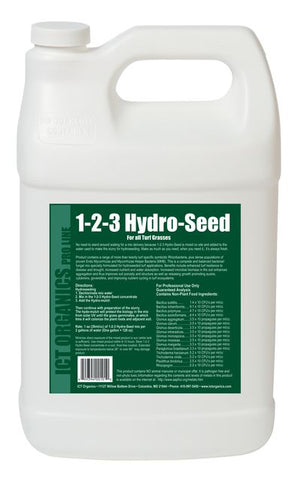
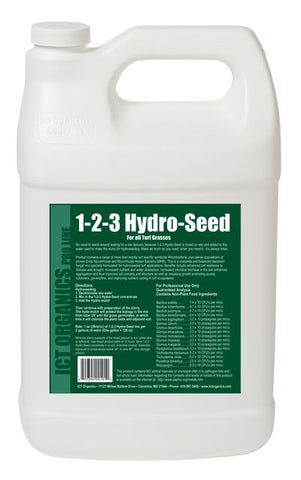
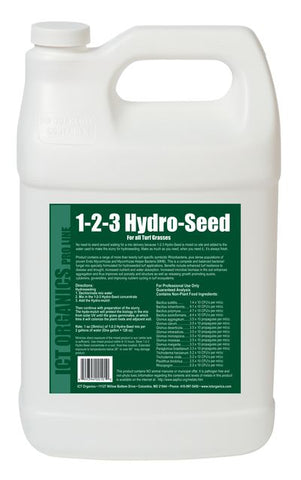
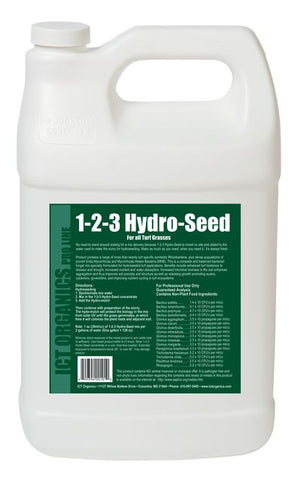
What we stock: the biological and soil-prep side of the job. ICT Organics 1-2-3 Hydro-Seed is a live microbial inoculant that goes straight into the hydroseeder tank, alongside soil test kits to set your lime and gypsum rates, the amendments themselves, humic and kelp soil conditioners, starter and turf fertilisers for the 4–6 week feed, and sprayers for applying any of it on smaller ground. We do not sell hydroseed mulch, tackifier or grass seed — source those locally, since freight on mulch usually costs more than the mulch.
How hydroseeding works
- Prep the soil. Rake out debris, break up compaction, and correct pH — lime to raise it, gypsum to loosen heavy clay. Most turf grasses want pH 6.0–7.0.
- Mix the slurry. Seed, mulch, tackifier and water in the tank. Add the microbial inoculant at this stage.
- Spray evenly. Overlap passes. Thin spots are where weeds establish.
- Keep it damp. Light watering 2–3× daily for the first 2–3 weeks. This is the step people fail.
- Feed at 4–6 weeks, once the stand is established, with a starter or turf fertiliser.
Dosing the microbial inoculant
| Application | Rate |
|---|---|
| Hydroseeding — in tank | 1–2 oz per 1,000 sq ft |
| Overseeding / lawn rejuvenation | Foliar drench with a standard sprayer |
| Coverage, 1 gallon | Treats up to 4 acres |
| pH | 6.8–7.2 |
| Live microbe count | Over 10 billion CFU/mL |
| Shelf life | 12 months sealed, 6 months once opened |
Shake before use, and it tank-mixes with most fertilisers and mulches. Store cool and dark — do not freeze, since freezing kills the culture.
Test the soil before you buy amendments
Lime and gypsum do opposite jobs, and applying the wrong one is worse than applying neither. A $20 test kit tells you which you need and at what rate — it is the cheapest step in the whole job and the one most often skipped.
| Reading | What it means | Fix |
|---|---|---|
| pH below 6.0 | Acidic — nutrients lock out, turf thins | Garden or dolomite lime |
| pH 6.0–7.0 | Target range for most turf grasses | Nothing |
| pH above 7.5 | Alkaline — iron and manganese lock out | Elemental sulphur, not gypsum |
| Heavy clay, water pooling | Compaction, poor structure | Gypsum — it changes structure, not pH |
Gypsum is the common misunderstanding: it loosens heavy clay by displacing sodium, but it does not raise pH. If your soil is acidic and compacted, you need both.
What tank-mixes and what doesn't
- Goes in the tank: the microbial inoculant, soluble humic acids, soluble kelp, and solution-grade gypsum. Anything labelled soluble or solution grade is formulated to dissolve rather than settle out.
- Goes on the ground first: prilled and granular lime, granular gypsum, granular humic. These are spread and worked in before you spray — they will clog a hydroseeder.
- Goes on afterwards: starter and turf fertilisers at 4–6 weeks, once the stand has established.
If you are treating a small area and not renting a hydroseeder, a backpack sprayer applies the inoculant as a drench perfectly well — that is the standard overseeding method.
DIY or hire a contractor?
| DIY | Contractor | |
|---|---|---|
| Equipment | Rent a hydroseeder, typically by the day | Included |
| Best for | Small to mid lawns, flat ground | Large areas, steep slopes, erosion control jobs |
| Main risk | Uneven coverage and under-watering | Cost |
| Materials | You buy seed, mulch, tackifier, inoculant | Priced into the job |
Costs vary widely by region, terrain and how much soil prep is needed, so treat any per-square-foot figure you read as a starting point and get a local quote. As a rule of thumb, hydroseeding lands well below sod and above plain broadcast seeding.
Getting germination right
- Water is the whole game. The mulch layer must stay damp until germination. Let it dry once and you lose the stand.
- Don't mow too early. Wait until the grass is about 3 inches.
- Seed to the season. Cool-season grasses go down in early autumn or spring; warm-season in late spring.
- Fix pH first. Correcting soil pH after the lawn is in is far harder than before.
- Don't fertilise heavily at seeding. A starter feed at 4–6 weeks beats a heavy dose on day one.
Frequently asked questions
How long does hydroseed take to germinate?
Typically 5–10 days to sprout and 3–4 weeks to a usable stand, depending on grass type and soil temperature. Keeping the mulch damp matters more than any other factor.
Can I hydroseed myself?
Yes. Hydroseeders can be rented, and the materials are straightforward. Even coverage and consistent watering are what separate a good DIY result from a patchy one.
Do I need a microbial inoculant?
Not strictly, but it targets the common failure mode — seed germinating into biologically dead or compacted soil and then stalling. It's a small share of total job cost.
Is hydroseeding better than sod?
It costs considerably less and roots into the native soil rather than sitting on it, but you wait weeks for a lawn instead of hours. Sod wins on speed, hydroseed on price and root establishment.
When should I fertilise after hydroseeding?
Around 4–6 weeks, once the stand has established, using a starter or turf fertiliser.
Lime or gypsum — which do I need?
Lime raises pH on acidic soil. Gypsum loosens compacted clay and does not change pH. Test first; they solve different problems and are not interchangeable.
Can I apply the inoculant without a hydroseeder?
Yes. For overseeding or smaller areas, apply it as a drench with a standard backpack or tank sprayer. The tank is a convenience, not a requirement.
Do you sell hydroseed mulch and grass seed?
No — we stock the microbial inoculant and the soil-prep and turf products around it. Mulch and seed are heavy and freight-sensitive, so buying those locally almost always works out cheaper.
Related
Lawn care · Organic growing · Fertilisers and nutrients · What is hydroseeding — beginner's guide